Food and Travel Tips To Minimize Flares While On Vacation
Jun 22, 2026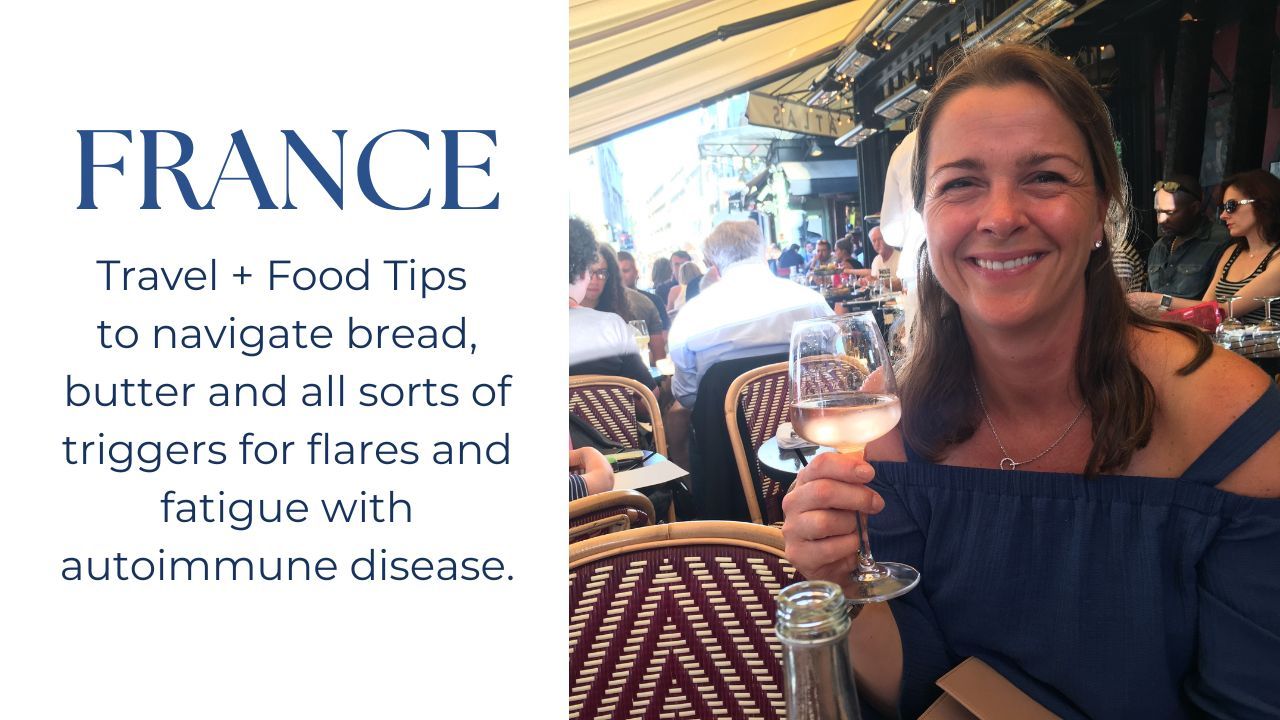
One of the biggest concerns I hear from people when it comes to eating a therapeutic diet for their autoimmune disease to address pain, fatigue or metabolic health are worries around travelling ... "How can I do this when on vacation?"
And it get it. Most people believe it will be too difficult to follow when having fun, or they will fail if they try so why bother?
When it's your first time travelling or going on vacation while working on nutrition and lifestyle changes to support yourself, I totally understand how un-nerving or restrictive following a "diet" or plan can feel. I remember travelling the first few times after our celiac and CRMO diagnosis, worried my daughter was going to have a bone flare after walking all day in Italy.
But we were okay and you will be too. The key to having a great time (while also being mindful of your nutrition plan) is being intentional with your decisions.
I mean if you decide you want to have an extravagant meal, no one is stopping you, nor should you feel guilty or like you've failed. That's called living a beautiful life and being an adult who can make daily decisions about how you're spending your time.
On the flip side, when all rules go out the door for 7 - 14 days, it can spell disaster for inflammation, pain and fatigue longer term. In my case and when I'm not mindful about what I'm eating, my sleep quality is terrible even if I can hear the ocean lapping in the background. My feet will swell, it hurts to walk, and I'll get lower back pain. I also tend to bloat (I don't like looking pregnant when my youngest is 19), have bathroom problems AND I get pretty irritable.
This means a version of me who is no fun to travel with and it's also not how I want to spend my vacation (tired, sore, bloated and grumpy).
In my case, I have a severe allergy to hazelnuts, dairy isn't always nice to me, and I've been 100% gluten free since 2018 when both my daughter and I were diagnosed with the celiac gene and our medical teams advised us to proceed with the diagnosis. From a food standpoint, there isn't a lot of wiggle room YET I can still eat like a queen and want for nothing.
This week, I'm away in France (the land of croissants, baguettes, cheese and butter) with my besties from highschool (still friends after 30+ years).
Having lived in France and travelled quite a bit, I can say with 100% confidence that France is probably one of the LEAST autoimmune-food friendly, food sensitivity or food allergen friendly countries in the world. When you mention "allergy" or whatever food accommodation you need, the waiters will crinkle their noses and put on a fake smile while the hair sticks up on their backs (or at least that's my experience).
And I still am able to eat with confidence, knowing how to stick to my plan without fear or feeling deprived.
The destination was picked on purpose as one of our group lives in the south, full time. Her and I went to work in our early 20s (avoiding "real life") and she never came home. I've been back multiple times, and with this blog, you get the benefit of my years of travelling and workarounds in a culture that's not very accommodating to food issues.
Here's how I stick to my diet when travelling with girlfriends who want to stop and drink rose at every corner, surrounded by baguettes, croissants, butter and cheese.
Planes and Trains (Toronto > Paris > South Of France):
Most airports and airplanes (even Air France) offer gluten free and specialty items. I find that gluten free meals on the plane are typically chicken, rice and 2 pieces of broccoli, and everything is loaded with cheese and cream. I don't do well with that, so I will:
- Have a really good meal at a proper airport restaurant before I board. I'll get a steak or chicken dish with a salad, vegetables and rice. For short flights or overnight, this works well as I'm not starving when I land. Most airports have an app you can use to check out allergies to find what works for you.
- Depending on how long the flight is, I'll pick up vegetables and fruit from the airport grab-and-go kiosks to round out the "plane" meals. Or I'll grab a big hearty salad that others will look at with envy when they're served their noodle cup. I also pack protein bars and nuts/seeds on me, if it's a really long flight. It's usually too much food, but any temptations or hunger pangs are covered.
On the plane, I don't wear compression socks, but many of my clients and family members do because they find they help. Instead, I'm the annoying person who pumps their ankles, gets up and walk around. I'll stretch and do mini twists in a subtle, not annoying way.
I also drink at least 1.5L of water with vitamin C travel packs while on the plane (not as much for a four hour flight). Dehydration will increase fatigue and pain. Sometimes it means I have to pop into the ladies room when we land (before customs), but sooo worth it for inflammation and fatigue.
Once in Europe, getting around by train is the norm. It's my experience that train stations (in any city I've visited) are terrible for food choices, and the "restaurants" on board typically only serve tuna or ham sandwiches, cookies and coffee.
This means I need a similar strategy as the airplane and will have a proper meal before boarding. Sometimes, I will preorder a meal to go from the hotel or a local restaurant which can be helpful if it's a long trip or overnight fare.
Big City Food Adventures
I live and breathe by the "Find Me Gluten Free" app when travelling to different cities in my home country and abroad. Users provide ratings and celiac-friendly establishments are highlighted. It has served me well in New York, LA, London, Paris, Rome, Florence and even small towns in Italy and France that produce freshly baked gluten free buns at the restaurant when requested! In these cases, I've even asked the restaurants to sell me a couple that I can take back to the rental or hotel.
When eating out (wherever I travel and even at home), I always go simple and rarely share a meal with others, unless it's my sister who follows the same food plan I do.
In Paris, I'll be sticking to omelettes for breakfast, and steak, fish, mussels and salads (Nicoise) for lunch and dinner, which you can get at pretty much any restaurant on any corner. I rarely order gluten free pasta in restaurants because I can make this at home as good as theirs (or better), so I pick what I don't have access to or is a bit different than what I make for my family.
There are also some amazing "foodie" places like Dessance (Michelin star) that offer gourmet gluten free tasting menus when reserved in advance. Dessance was honestly one of the best meals I've ever had in my life (french/south american fusion)!
While in a big city like Paris, I head into little grocery stores for snacks (nuts, seeds, meat counter) when my girlfriends head to the crepe truck. Lucky for me, one of my friends on this trip is also gluten free (she also has an autoimmune and going gluten free has helped her joints and hormones substantially). The two of us will definitely be heading to a gluten free bakery or two (there are many more now than when I was there last in 2019).
Ice cream? No thank you. I'll grab a sorbet instead.
Big City Down Time
The key to navigating time changes (sleep deprivation is a major trigger for inflammation and flares) is to get climatized to the new time zone as quickly as possible. If I'm arriving in the morning and running on a terrible sleep from the plane, I don't take any chances. When travelling to Europe, I often book a hotel or AirBnB for the night before so I can walk straight in and have a two-hour nap. That extra cost means I'm able to sleep, get up, have a shower and feel refreshed. Then, I'm able to visit a couple of things late afternoon, have dinner and go to bed at a good hour, on local time. When travelling so far, this extra night's stay is worth its weight in gold.
All the walking on concrete, dodging the hoards of people and standing in galleries can also be hard on the lower legs and back. I personally love the subway or (if you're short on time for seeing things) the hop on/off bus to see a new city is fun. You get some sunshine, a great view and can walk or ride as much as you like.
Lunches are long and leisurely, and I seek out parks for a quiet moment, taking in the sights, sounds and people. It's a good way to get rid of some of the frenetic energy of the tourists and chaos of major cities and attractions.
Back at the hotel, I always put my legs up the wall or on a chair to help with fatigue, lymph flow and my nervous system. It's a powerful restorative pose you can do anytime, any place.
I've also packed favourite Kalaya cream (has arnica and camphor), bands for stretching and Dr Ho's (just in case).
When in France, I'll specifically be looking for Traumeel at their pharmacies. French doctors are trained in homeopathics and the pharmacy will have lots of natural and traditional medicines. Traumeel is a wonderful homeopathic (oral and cream) that we can no longer get in North America. I've used it for years with broken bones, bruises and other mishaps for myself and my kids (skiing). Even with my daughter's first flare - it was soooo helpful in managing pain. Unfortunately, they pulled out of Canada and the US years ago and it's too bad because it's a great, effective product and nothing seems to compare. Before you google, please be aware of the amazon products (they're not sold in the US or Canada anymore). It may be a scam.
Rent A Home And Stay In Rhythm (En Provence)
I much prefer AirBnB when travelling versus a hotel because I can control what I eat and when. We have done so for the majority of our family trips since my daughter's autoimmune diagnosis. It's actually less expensive and everyone prefers it because there are spaces to hang out, unwind and truly decompress versus a small, cramped hotel room where you pay $20 for a bottle of water.
For the rental, I'm packing protein powder and chia seeds for smoothies and high-protein breakfast puddings, and a 1lb bag of almond flour so I can make bread while there (weird, but I enjoy it). Any additional speciality items can easily be ordered online in advance, but really, those three items are all I need, so I just bring them with me.
And then, I try to blend in with the locals and soak up the true beauty of the culture and people.
Fruit and vegetables are grabbed at the market and we'll tag on a sight seeing event with it. For example, this trip, I'm forcing my friends to go to the Arles market. It's one of the biggest in the south of France and there is also a colosseum/ampitheatre commissioned shortly after the one in Rome was complete (I want to say it was Caesar's grandson, but I could be wrong). They are going to love it.
Meat, cheese will be grabbed at specialty shops as needed, and yes, we will also be going to the regular grocery store for water, staples and other things for poolside relaxation. Rose will absolutely be involved as it is the premier region of the world! I don't partake as much as the others, but that's okay as I can live vicariously through them and will giggle with their silliness.
I also prefer eating at restaurants for lunch versus dinner. It's an easy add-on to site seeing and a long, leisurely lunch creates the opportunity to rest (important). I use the same meal-choosing formula that I use at every restaurant I go to (simple protein and veg, no sauces), which makes it easy for me and those I'm travelling with. When back at the rental, food is always light, easy and fun to cook with friends: salads, fish dishes, chicken ... making use of what is in season, local and available.
Downtime at the rental looks like reading, cards, dice games (right, left, centre), floating in the pool, and doing a little mobility yoga and lymph drainage (all that walking) with classes from our membership (Integrative Autoimmune Membership).
And lots of legs up the wall ... the best pose ever.
Conclusion:
- Eat before getting into planes, trains and automobiles, and pack protein or fibre-packed snacks.
- Naps make you (and the world) a better place.
- Plan meals in advance or use the Find Me Glute Free app to help you make choices or find special places you never would have known about.
- Take breaks in parks to decompress from the city chaos, and put your legs up the wall when at your hotel or home.
- Stick to your routine as much as possible, AND you can still indulge in some speciality meals.
I hope you found this helpful. If you like this blog (or want others), let me know and I'll consider it).
Bisous!